

-
$134.95 AUDUnit price /Unavailable
-
$194.95 AUDUnit price /Unavailable
-
$124.95 AUDUnit price /Unavailable
-
$69.95 AUDUnit price /Unavailable
-
$39.95 AUDUnit price /Unavailable




Riders crash. Not often, but often enough, and usually a long way from the car with gravel in the wound and nobody around.
WHAT ACTUALLY FITS ON A BIKE
A jersey pocket, a saddle bag, a hip pack or the lid of a hydration pack. That is the entire budget, and it rules out most kits.
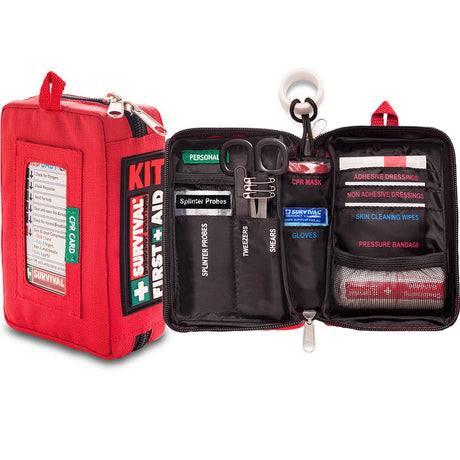
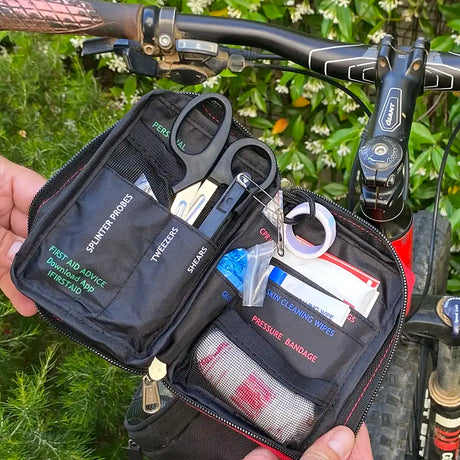
The SURVIVAL Slimline First Aid KIT is built for exactly this. At 4cm thick it slides into a hydration pack or a jersey pocket without creating a lump you feel on every pedal stroke, and it carries a SMART Bandage and a SURVIVAL Splint rather than just plasters. Mountain biking is named on its own product page as a use case.
The SURVIVAL Compact First Aid KIT clips to a pack strap. The SURVIVAL Wallet 2.0 is the minimum, and it is better than nothing by a wide margin.
GRAVEL RASH IS THE INJURY
Every other consideration is secondary. A slide on gravel or bitumen produces a large, dirty, shallow wound that hurts for a week if it is not cleaned and covered properly.
It needs irrigating and a dressing that will not bond to the raw surface. A handful of adhesive strips does not do that job, and picking a stuck dressing off a fresh graze two days later is the part people remember.
HOW FAR ARE YOU FROM THE CAR
This is the question that decides how much you carry.
A lap of a local trail network means you are twenty minutes from the car park at worst. A point-to-point ride, a bikepacking trip, or a big day in the hills means you might be hours out, on a track an ambulance cannot reach, with a bike you can no longer ride.
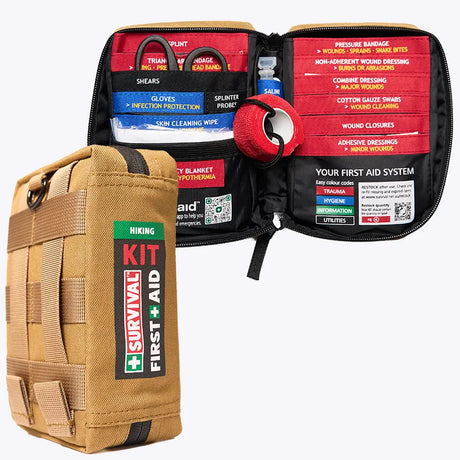
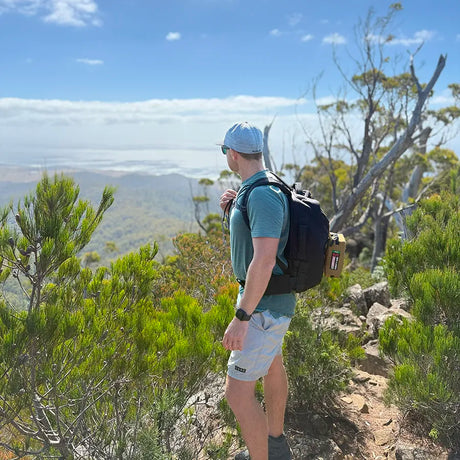
For the longer days, add the ability to strap an injury well enough to walk out on it. The SURVIVAL Hiking First Aid KIT is 515 grams and covers that ground if your pack has room.
ROAD VERSUS TRAIL
Road riders crash at higher speed with traffic involved. The injuries skew toward serious: collarbones, head knocks, and the possibility of being hit.
Trail riders crash more often at lower speed, with more cuts, more impact injuries from the bike itself, and a much longer walk back.
Either way, carry gloves. Treating a wound with dirty hands after a crash is how a graze becomes an infection.
RIDING IN A GROUP
Agree before you roll out who has a KIT and where it is on their bike.
The common failure is six riders who all assumed someone else was carrying. One person with a proper KIT covers the group, but only if the group knows.
